


Everything you own, in one place.
Orderist finds your accounts, memberships, pensions, property, insurance and documents, and keeps them current — so you're always ready when life changes.


When someone dies in the UK, their bank accounts and most financial products are frozen until the person dealing with the estate, usually the executor, can prove they're entitled to access them. That normally means applying for probate. Pensions, property, insurance and digital accounts each follow their own rules and their own providers, and nobody notifies them automatically. The government's Tell Us Once service covers most public bodies in one go; everything else has to be contacted separately.
Most people don't find out how any of this works until they're the one doing it, usually at the worst possible time to be learning something new. This guide sets out, in order, what actually happens to a person's money, property, pensions, insurance and digital accounts after they die in the UK, who needs to be told, and roughly how long each part takes.
The moment a bank, pension provider or insurer is told that an account holder has died, that account is frozen. No withdrawals, no direct debits, no online access, until whoever is dealing with the estate can prove they have the legal right to act. For a joint account, the surviving holder usually keeps access; for anything held in one name only, it stops.
This is deliberate and it applies to every financial institution, not just banks. It protects the estate from being accessed by the wrong person, but it also means that funeral costs, mortgage payments and household bills often need to be paid from somewhere else in the meantime. Most banks will release a limited amount directly to a funeral director on production of the invoice and a death certificate, before probate is granted.
Before any of the financial admin can start, the death has to be registered. In England and Wales this must happen within 5 days of the medical examiner confirming the cause of death (8 days in Scotland). Registering the death produces the certificate needed for the funeral, and a number of copies of the death certificate itself, which will be needed repeatedly over the following weeks.
Once the death is registered, the government's Tell Us Once service lets you notify most public bodies in a single call or online form, including HM Revenue and Customs, the Department for Work and Pensions, the passport office, the driving licence agency, and the local council. It's available across most of England, Scotland and Wales, and is usually offered by the registrar at the point of registration.
Tell Us Once does not cover private organisations. Each of the following has to be contacted separately, individually, usually with a copy of the death certificate:
● Banks, building societies and any account held anywhere the person banked.
● Private and workplace pension providers.
● The employer, if the person was still working.
● Insurance providers (life, home, car).
● Utility companies, landlords or mortgage lenders.
● Any subscriptions, memberships or digital accounts (covered in more detail below).
This is the part of the process people consistently underestimate. Someone with three bank accounts, two old workplace pensions, a mortgage and a handful of subscriptions is a very ordinary financial picture in the UK, and each of those has to be found and notified individually because there is no single register that shows what a person actually held.
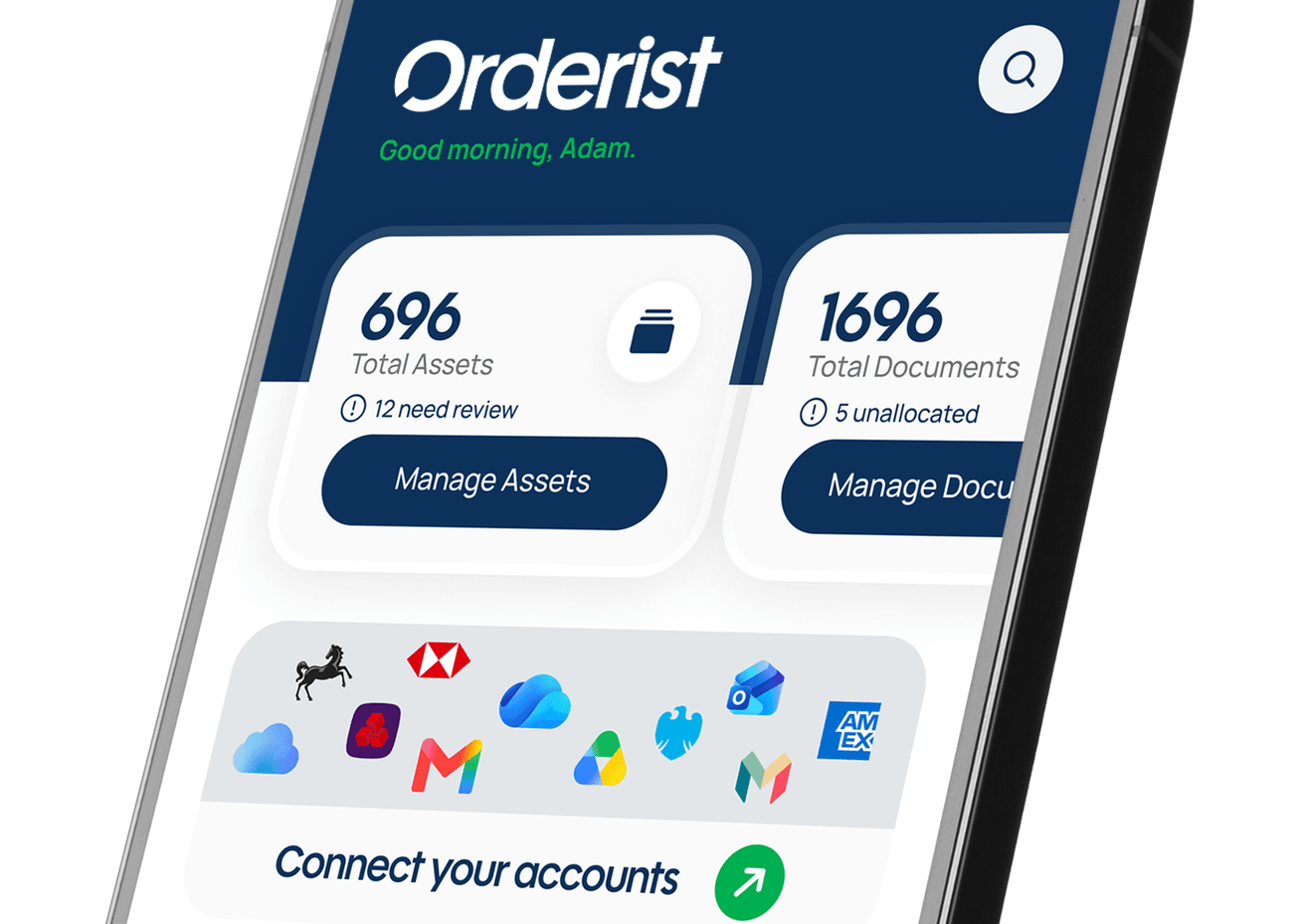
A current record built while someone’s alive closes exactly that gap. It’s what Orderist's Asset Register is for: it finds and organises everything a person owns, in one place, so whoever’s left dealing with it later isn’t starting from nothing.
A sole-name account is frozen as soon as the bank is notified. Standing orders and direct debits from that account stop, and no one, including anyone with previous power of attorney, can use it. Power of attorney ends automatically on death; it has no further effect at all.
To release the funds, the bank will usually ask for the death certificate, proof of who is entitled to deal with the estate (the grant of probate, or letters of administration if there's no will), and identification. Many banks will release small estates below a set threshold, commonly a few thousand pounds, without a full grant of probate, but this varies by bank and by the amount involved.
A joint account works differently. Money in a joint account usually passes automatically to the surviving account holder by survivorship, without needing probate, though the bank still needs to be told so the account can be updated to a single name.
Pensions sit outside the estate in most cases and are dealt with directly by the pension provider, not through probate.
● Workplace and personal pensions (defined contribution): the scheme normally pays out to whoever is named on the beneficiary nomination form, sometimes called an "expression of wish." This form is not legally binding in the way a will is, but providers almost always follow it, which is exactly why it needs to be kept up to date. Many people fill this in once, when they join a scheme, and never look at it again.
● Final salary (defined benefit) pensions: these often pay a reduced pension to a spouse, civil partner or dependant, under the scheme's own rules, rather than a lump sum.
● The State Pension: this stops on death and is not inherited directly, though a surviving spouse or civil partner may be able to claim an increase to their own State Pension in some circumstances, depending on National Insurance contributions.
The practical problem is that most people accumulate several pensions over a working life, often from employers they left years ago, and the people left behind frequently don't know they exist. Government estimates put the number of lost or forgotten pension pots in the UK in the millions, and the free Pension Tracing Service can find contact details for a pension scheme if you know the employer or provider's name, though it cannot confirm a pension exists or what it's worth.
What happens to a house or flat depends entirely on how it was owned.
● Owned as joint tenants (the common way for married couples and civil partners to own a home together): the property passes automatically and entirely to the surviving owner, outside the will and outside probate, by survivorship.
● Owned as tenants in common: each owner's share is treated as part of their own estate and passes according to their will, or under intestacy rules if there isn't one. This is more common with unmarried couples, second marriages, or anyone who has specified unequal shares.
● Owned solely by the person who died: the property forms part of the estate and cannot usually be sold or transferred until probate has been granted.
A mortgage does not disappear on death. It transfers with the property, and the executor or new owner needs to keep payments up to date, or arrange with the lender, while probate is being sorted out.
Life insurance pays out to whoever is named as the beneficiary, and if the policy is written into a trust it can pay out quickly, without waiting for probate at all. Without a trust, the payout usually goes to the estate and is dealt with as part of it.
Other policies need a decision, not just a notification. Buildings and contents insurance on a property that's now empty often needs updating, since standard home insurance can be invalidated by a property being unoccupied for an extended period. Car insurance should be cancelled or transferred rather than left to lapse or auto-renew.
This is the newest and least standardised part of the process, and it's growing every year as more of what a person owns and manages exists only online.
Every major provider now has some form of policy, but none of them are consistent with each other and most people have never looked at any of them:
● Google has an Inactive Account Manager, which a person can set up in advance to decide what happens to their account (nominate a trusted contact, delete data, or both) after a period of inactivity they choose.
● Apple has a Legacy Contact feature, set up in advance in Settings, which allows a nominated person to access certain account data after death on production of a death certificate and an access key.
● Meta (Facebook and Instagram) allows an account to be memorialised, turned into a permanent, viewable tribute, or deleted, depending on what was set in advance or what next of kin request afterwards.
The common thread across almost all of them: the options are far more useful if they're set up while the person is alive, and close to useless if nobody thought to do it. There is no single register of what accounts a person even had, which is often the first genuine obstacle: the executor doesn't know an account exists until a bill arrives, a login prompt appears, or a service simply stops working and someone eventually notices.
Beyond the well-known platforms, "digital assets" also covers things people don't tend to think of as accounts at all: cryptocurrency wallets (which can be permanently lost without the private key, with no provider to appeal to), domain names, cloud storage containing photos and documents, and loyalty points or airline miles, some of which have their own transfer rules.
Orderist's Digital Vault and Asset Register exist to close that specific gap while someone’s still around to fill them in, rather than leaving an executor to reconstruct the list afterwards.
Probate is the legal process that gives someone (usually the executor named in the will, or a close relative if there's no will) the authority to deal with the estate: closing accounts, selling property, paying debts and distributing what's left.
It isn't always required. Jointly owned assets that pass by survivorship don't need it, and many banks will release small amounts without it. But for anything solely owned, above a bank's own threshold, or where property needs to be sold or transferred, probate is generally unavoidable.
There's no single timeline because it depends on how many institutions are involved and how organised the paperwork already was, but a rough shape looks like this: registering the death and starting Tell Us Once happens in the first one to two weeks; notifying banks, pensions and insurers and starting to value the estate takes several more weeks; applying for and receiving probate typically adds around 12 weeks on top of that; and closing accounts, transferring or selling property, and finally distributing the estate to beneficiaries can take several more months after probate is granted. A straightforward estate can be substantially wrapped up within six months. A more complex one, several properties, several pensions, or anything contested, can take well over a year.
1. Register the death (within 5 days in England and Wales, 8 in Scotland) and get copies of the certificate.
2. Use Tell Us Once for government departments.
3. Notify the bank, employer, pension providers and insurers directly.
4. Work out whether probate is needed, and value the estate.
5. Apply for probate if required.
6. Close, transfer or sell accounts, property and policies once granted.
7. Settle any debts and distribute what remains to beneficiaries.
Register the death, which must happen within 5 days in England and Wales (8 days in Scotland). This produces the death certificate needed for almost everything else, including the funeral and notifying banks and pension providers.
Yes, for anything held in a sole name. Joint accounts usually pass to the surviving holder automatically and stay accessible, but the bank still needs to be told.
No. Assets held jointly usually pass by survivorship without probate, and many banks release small balances without it. Probate is generally needed for solely owned assets above a bank's threshold, or where property must be sold or transferred.
Most pensions sit outside the estate and are paid out directly by the provider, usually to whoever is named on the scheme's beneficiary nomination form, rather than according to the will.
It depends on the platform. Google, Apple and Meta each offer a way to nominate a contact or set preferences in advance; without that, next of kin generally have to contact each platform separately with a death certificate, and outcomes vary.
This article is informational and does not constitute legal, financial or tax advice. If you're dealing with a complex estate, or are unsure of your position, we'd recommend speaking to a solicitor.